


Orders

Profile

Coconut Water During Pregnancy: 11 Benefits, How Much to Drink and Safety (2026 Guide)
 473 Likes|
 15 min
AI-Generated Summary
Quick overview in 30 seconds.webp&w=32&q=75)
Summary
- Coconut water during pregnancy is rich in essential nutrients like potassium, magnesium, calcium, and vitamin C, supporting healthy development of both the mother and the growing baby.
- Drinking coconut water helps prevent dehydration, reduces morning sickness, regulates blood pressure, aids digestion, and provides a natural energy boost for expectant mothers throughout pregnancy.
- Choose fresh, unpasteurized coconut water and consume in moderation. Avoid packaged versions with added sugars, and consult your healthcare provider before adding it to your diet.
- Looking for healthy hydration support during pregnancy? Explore our Baby Wellness Kit | Skincare Gift Set for Newborns.
TL;DR
Coconut water during pregnancy is safe and beneficial in moderation. It is a natural source of electrolytes (potassium, magnesium, sodium), vitamin C and antioxidants that help with hydration, morning sickness, mild heartburn, blood pressure balance and energy (Cleveland Clinic) (ICMR Dietary Guidelines). It is low in calories and naturally fat-free, making it a healthier choice than sugary drinks. Most women can safely enjoy 1 to 2 glasses (about 250 to 500 ml) per day as part of their total fluid intake. Choose fresh, tender coconut water over packaged versions with added sugar. It is NOT a substitute for water, medicine or a balanced diet. Women with gestational diabetes or kidney issues should ask their doctor first.
Quick Answer
Coconut water is safe and healthy during pregnancy in moderation. It provides natural electrolytes, vitamin C and antioxidants that aid hydration, ease nausea and support energy. Most women can drink 1 to 2 glasses (250 to 500 ml) daily as part of their fluids. Choose fresh over packaged, and check with your doctor if you have diabetes or kidney problems.
Author: Anupama Chadha, Senior Nutrition Content Editor, Mylo Parenting Desk Medically reviewed by: Mylo Editorial Board, aligned with ICMR Dietary Guidelines for Indians, ACOG and FOGSI nutrition guidance Last updated: 11 June 2026
Medical Disclaimer: This article is for informational purposes only and is not a substitute for professional medical or dietary advice. If you have gestational diabetes, kidney disease, high potassium levels or any dietary restriction, consult your doctor or dietitian before making coconut water a regular part of your diet.
Key Takeaways
- Coconut water is safe and beneficial in pregnancy in moderation (Cleveland Clinic)
- It is rich in potassium, magnesium, sodium, vitamin C and antioxidants
- Helps with hydration, morning sickness, heartburn, energy and BP balance
- Low in calories and fat-free, a healthier choice than sugary drinks
- Safe amount: about 1 to 2 glasses (250 to 500 ml) per day
- Fresh tender coconut water is best; avoid packaged versions with added sugar
- It does NOT replace water, a balanced diet or medical treatment
- Women with gestational diabetes or kidney problems should consult a doctor first
Is Coconut Water Good During Pregnancy?
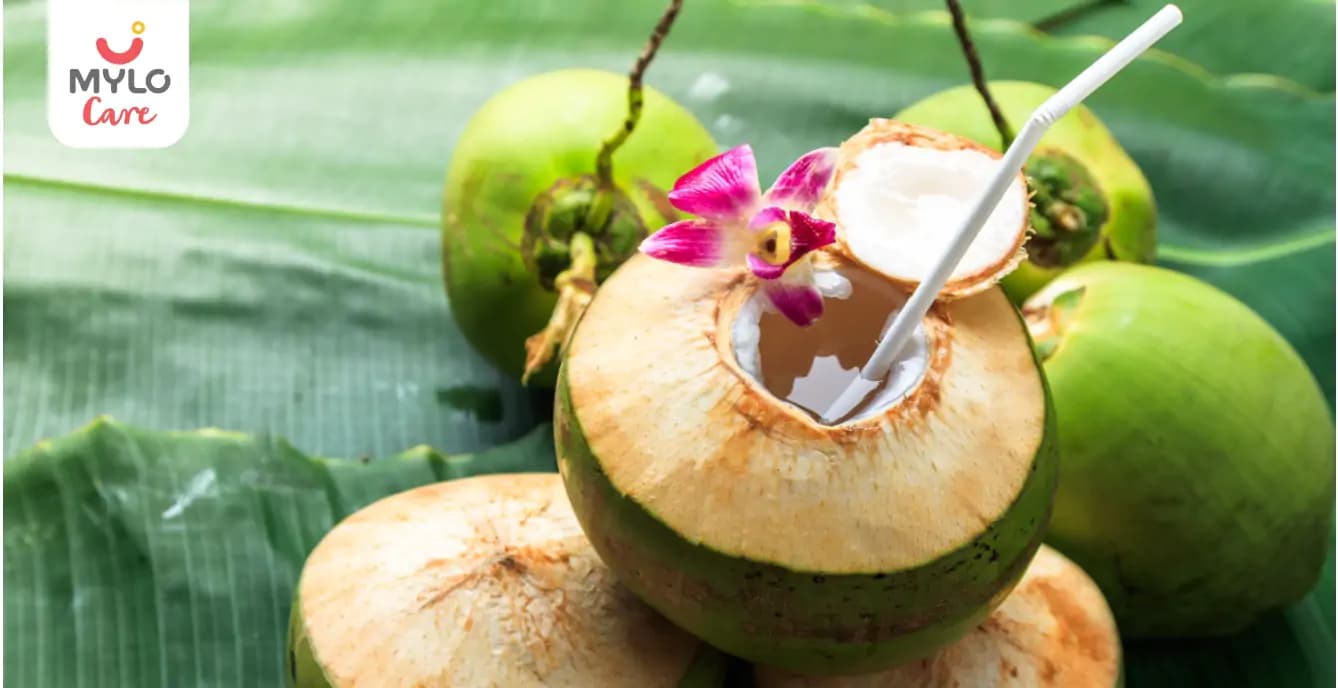
Yes. Coconut water (the clear liquid inside young, green tender coconuts) is a natural, hydrating drink that is generally safe and healthy during pregnancy (Cleveland Clinic).
It is naturally:
- Low in calories
- Fat-free and cholesterol-free
- Rich in electrolytes (potassium, sodium, magnesium)
- A source of vitamin C and antioxidants
This makes it a much better choice than packaged juices, sodas or sugary drinks during pregnancy (ICMR).
Note: Coconut water is healthy, but it is a complement to plain water, not a replacement. Plain water should still be your main source of hydration.
What Is the Nutritional Value of Coconut Water?
Approximate nutrition per 100 ml of fresh tender coconut water (USDA FoodData Central):
| Nutrient | Approx. Amount (per 100 ml) | Role in Pregnancy |
|---|---|---|
| Calories | About 18 to 19 kcal | Low-calorie hydration |
| Potassium | About 250 mg | Fluid balance, BP, muscle function |
| Sodium | About 105 mg | Electrolyte balance |
| Magnesium | About 25 mg | Muscle and nerve function |
| Calcium | About 24 mg | Bone health |
| Carbohydrates | About 3.7 g | Light natural energy |
| Vitamin C | Small amount | Immunity, iron absorption |
Exact values vary by coconut maturity and source. Tender (young) coconut water is lighter and less sugary than mature coconut water.
What Are the 11 Benefits of Coconut Water During Pregnancy?
1. Keeps You Hydrated
Pregnancy increases your fluid needs. Coconut water's electrolytes help maintain hydration, especially in India's hot climate (ICMR).
2. Replenishes Electrolytes
Natural potassium, sodium and magnesium help replace electrolytes lost through sweating or vomiting (morning sickness) (Cleveland Clinic).
3. May Ease Morning Sickness
Its light, mild taste and electrolytes can settle the stomach and help with nausea and vomiting in early pregnancy (NHS Morning Sickness).
4. Supports Digestion and Reduces Constipation
Coconut water adds fluid and is gentle on the gut, which can ease pregnancy constipation and bloating.
5. Helps Relieve Heartburn
Many women find coconut water mildly soothing for acidity and heartburn, common in later pregnancy (Cleveland Clinic Heartburn).
6. Supports Healthy Blood Pressure
The potassium and magnesium content support normal blood pressure balance (NIH ODS Potassium).
7. Provides Natural Energy
Light natural sugars and electrolytes offer a gentle energy boost to fight pregnancy fatigue, without the heavy sugar of sodas.
8. Boosts Immunity
Vitamin C and antioxidants support a healthy immune system during pregnancy (NIH ODS Vitamin C).
9. Low in Calories for Healthy Weight
A naturally low-calorie, fat-free drink that satisfies thirst without excess weight gain (ICMR).
10. Supports Kidney Function and May Reduce UTI Risk
As a natural mild diuretic, it promotes urination, which helps flush the urinary tract (UTIs are common in pregnancy) (NHS UTI).
11. Helps Maintain Amniotic Fluid Hydration
Good overall hydration supports healthy amniotic fluid levels, and coconut water contributes to your daily fluid intake (Cleveland Clinic).
Reality check: Coconut water supports these benefits as part of a healthy diet and hydration routine. It is not a cure for any condition, and claims that it "makes the baby fair" or "gives the baby thick hair" are myths with no scientific basis.
How Much Coconut Water Should You Drink During Pregnancy?
| Aspect | Guidance |
|---|---|
| Daily amount | About 1 to 2 glasses (250 to 500 ml) |
| Best type | Fresh tender (green) coconut water |
| Best time | Morning or between meals; not a fixed rule |
| Avoid | Packaged versions with added sugar, preservatives or "flavour" |
| With diabetes | Ask your doctor; it still contains natural sugars |
| As hydration | Counts toward fluids, but plain water remains primary |
Drinking 1 to 2 glasses a day is plenty for most women. There is no need to overdo it; balance it with plain water and a varied diet (ICMR).
When Is the Best Time to Drink Coconut Water in Pregnancy?
There is no single "best" time, but these are popular and practical (Cleveland Clinic):
- Morning: Refreshing start; may help with morning nausea
- Between meals: Gentle hydration and energy
- After light exercise or a walk: Replenishes electrolytes
- In hot weather: Helps prevent dehydration
- Mid-afternoon: A healthier alternative to tea, coffee or sodas
Avoid drinking large amounts late at night if you already wake up frequently to urinate, as coconut water is mildly diuretic.
Can You Drink Coconut Water in Every Trimester?
Yes, in all three trimesters (Cleveland Clinic):
| Trimester | How It Helps |
|---|---|
| First (weeks 1 to 13) | Eases morning sickness, gentle hydration, light energy |
| Second (weeks 14 to 27) | Supports rising fluid needs, digestion, energy |
| Third (weeks 28 to 40) | Helps with heartburn, hydration, leg cramps (electrolytes) |
There is no trimester in which moderate coconut water is unsafe for a healthy pregnancy. The first-trimester myth that it must be avoided is not true.
What Are the Side Effects and Precautions?
Coconut water is safe for most, but keep these in mind (Cleveland Clinic):
Possible Side Effects
- Too much potassium: Excess coconut water can raise potassium levels, a concern for women with kidney problems (NIH ODS Potassium)
- Extra sugar (packaged): Sweetened packaged versions add sugar, a concern in gestational diabetes
- Mild diuretic effect: May increase urination
- Rare allergy: Very uncommon, but possible (itching, swelling, breathing difficulty), seek care if this happens
- Loose stools: In some people, large amounts can be mildly laxative
Precautions
- Choose fresh over packaged whenever possible
- Check with your doctor if you have gestational diabetes, kidney disease or high potassium
- Do not replace plain water entirely with coconut water
- Drink in moderation (1 to 2 glasses a day)
- Ensure hygiene: Drink from a freshly cut, clean coconut
Indian Context: Coconut Water for Indian Mothers
- Widely available and affordable: Fresh tender coconut (nariyal pani) is sold across India for INR 40 to INR 80 each, an easy, natural choice
- Great for the hot climate: Coconut water is one of the best natural drinks to prevent dehydration in Indian summers (ICMR)
- Prefer fresh roadside tender coconut: Choose a vendor who cuts it fresh in front of you for hygiene; avoid pre-cut or stored ones
- Cultural belief check: The popular belief that coconut water makes the baby "fair" or gives "good hair" is a myth; drink it for genuine hydration and nutrition, not appearance
- Pair with a balanced diet: Coconut water complements, but does not replace, dals, vegetables, fruits, dairy and whole grains
- Gestational diabetes: Common in Indian women; if you have it, ask your doctor before regular coconut water, as it contains natural sugars (FOGSI)
- Avoid packaged sugary "coconut drinks": Read labels; many contain added sugar and preservatives
Myths vs Facts About Coconut Water in Pregnancy
| Myth | Fact | Source |
|---|---|---|
| "Coconut water makes the baby fair" | False. Skin colour is genetic; no food changes it | ICMR |
| "Coconut water gives the baby thick hair" | False. No scientific basis | Cleveland Clinic |
| "You must avoid coconut water in the first trimester" | False. It is safe in all trimesters in moderation | Cleveland Clinic |
| "Coconut water can replace plain water" | False. It complements water but should not replace it | ICMR |
| "More coconut water is always better" | False. Excess can raise potassium and sugar intake | NIH ODS |
| "Coconut water cures morning sickness completely" | Partly false. It may ease nausea but is not a cure | NHS |
| "Packaged coconut water is as healthy as fresh" | False. Many packaged versions add sugar and preservatives | Cleveland Clinic |
FAQs: Coconut Water During Pregnancy
Is coconut water safe during pregnancy?
Yes. Coconut water is safe and beneficial during pregnancy in moderation (about 1 to 2 glasses a day). It provides natural electrolytes, vitamin C and antioxidants that support hydration and energy (Cleveland Clinic). Choose fresh tender coconut water and consult your doctor if you have gestational diabetes or kidney issues.
Pregnancy mein nariyal pani peena chahiye? (Hinglish)
Haan, pregnancy mein nariyal pani (coconut water) peena safe aur faydemand hai. Ismein natural electrolytes (potassium, magnesium), vitamin C aur antioxidants hote hain jo hydration, morning sickness aur energy mein madad karte hain. Din mein 1 se 2 glass (250 to 500 ml) kaafi hai. Fresh tender coconut chunein, packaged sugary versions avoid karein. Agar diabetes ya kidney problem hai toh doctor se poochein.
How much coconut water can I drink per day during pregnancy?
About 1 to 2 glasses (250 to 500 ml) per day is safe and sufficient for most women (ICMR). It should be part of your total fluid intake, not a replacement for plain water. Avoid overdoing it, especially if you have kidney or blood sugar concerns.
Does coconut water make the baby's skin fair?
No. This is a popular myth with no scientific basis (ICMR). A baby's skin colour is determined by genetics, not by anything the mother eats or drinks. Drink coconut water for hydration and nutrition, not to change the baby's appearance.
Can coconut water help with morning sickness?
It may help. The mild taste and natural electrolytes can settle the stomach and replace fluids lost from vomiting (NHS). Sip it slowly. It is a helpful aid but not a guaranteed cure for morning sickness.
Is coconut water safe in the first trimester?
Yes. Coconut water is safe in the first trimester and can actually help with early-pregnancy nausea and hydration (Cleveland Clinic). The belief that it must be avoided early on is a myth.
Pregnancy mein nariyal pani kab peena chahiye? (Hinglish)
Nariyal pani kabhi bhi pi sakti hain, lekin ye time popular hain:
- Subah (morning sickness aur freshness ke liye)
- Meals ke beech mein
- Walk ya halki exercise ke baad
- Garmi mein dehydration se bachne ke liye Raat ko zyada na peeyein agar baar baar washroom jana padta hai, kyunki ye thoda diuretic hai.
Can coconut water cause gestational diabetes or raise blood sugar?
Coconut water contains natural sugars, so large amounts or sweetened packaged versions can affect blood sugar. It does not "cause" gestational diabetes, but if you already have it, drink it only with your doctor's guidance and prefer fresh, unsweetened tender coconut water (FOGSI).
Is packaged coconut water as good as fresh?
No. Fresh tender coconut water is best. Many packaged versions contain added sugar, preservatives and flavourings that reduce its health benefits (Cleveland Clinic). If you must buy packaged, read the label and choose 100% coconut water with no added sugar.
Does coconut water increase amniotic fluid?
Coconut water does not "magically" increase amniotic fluid, but good overall hydration supports healthy amniotic fluid levels, and coconut water contributes to your daily fluids (Cleveland Clinic). If you have been told you have low amniotic fluid, follow your doctor's specific advice.
Can I drink coconut water every day during pregnancy?
Yes, drinking 1 to 2 glasses of fresh coconut water daily is safe for most healthy pregnancies (ICMR). Just keep it in moderation, prefer fresh over packaged, and check with your doctor if you have kidney problems or gestational diabetes.
Is coconut water good for heartburn in pregnancy?
Many women find it soothing. Coconut water is mildly alkaline and can help ease acidity and heartburn for some women (Cleveland Clinic Heartburn). It is a gentle, natural option, though it works differently for everyone.
Are there any women who should avoid coconut water?
Women who should check with their doctor first include those with (NIH ODS Potassium):
- Kidney disease (coconut water is high in potassium)
- High blood potassium (hyperkalaemia)
- Gestational diabetes (natural sugar content)
- A known coconut allergy (rare)
References
- Cleveland Clinic. "Coconut Water: Health Benefits." https://my.clevelandclinic.org/health/articles/coconut-water
- Cleveland Clinic. "Heartburn During Pregnancy." https://my.clevelandclinic.org/health/diseases/12011-heartburn-during-pregnancy
- NHS UK. "Vomiting and Morning Sickness in Pregnancy." https://www.nhs.uk/pregnancy/related-conditions/common-symptoms/vomiting-and-morning-sickness/
- NHS UK. "Urinary Tract Infections (UTIs)." https://www.nhs.uk/conditions/urinary-tract-infections-utis/
- NIH Office of Dietary Supplements. "Potassium." https://ods.od.nih.gov/factsheets/Potassium-HealthProfessional/
- NIH Office of Dietary Supplements. "Vitamin C." https://ods.od.nih.gov/factsheets/VitaminC-HealthProfessional/
- USDA FoodData Central. "Coconut Water, Raw." https://fdc.nal.usda.gov/
- ICMR / NIN. "Dietary Guidelines for Indians." https://www.nin.res.in/dietaryguidelines/pdfjs/locale/DGI07052024P.pdf
- ICMR (Indian Council of Medical Research). https://www.icmr.gov.in/
- FOGSI (Federation of Obstetric and Gynaecological Societies of India). https://www.fogsi.org/
Related Articles



Related Topics
.webp&w=32&q=75)
Medical Disclaimer
This content is for informational purposes only and should not replace professional medical advice. Consult with a physician or other health care professional if you have any concerns or questions about your health. If you rely on the information provided here, you do so solely at your own risk.


AWARDS AND RECOGNITION

Mylo wins Forbes D2C Disruptor award

Mylo wins The Economic Times Promising Brands 2022
AS SEEN IN












- Mylo Care: Effective and science-backed personal care and wellness solutions for a joyful you.
- Mylo Baby: Science-backed, gentle and effective personal care & hygiene range for your little one.
- Mylo Community: Trusted and empathetic community of 10mn+ parents and experts.


Product Categories
Baby Carrier | Baby Soap | Baby Wipes | Stretch Marks Cream | Baby Cream | Baby Shampoo | Baby Massage Oil | Baby Hair Oil | Stretch Marks Oil | Baby Body Wash | Baby Powder | Baby Lotion | Diaper Rash Cream | Newborn Diapers | Teether | Baby Kajal | Baby Diapers Pants | Cloth Diapers | Laundry Detergent | Lactation Granules |