

Orders
.png&w=48&q=75 "login")
Profile


Wallet

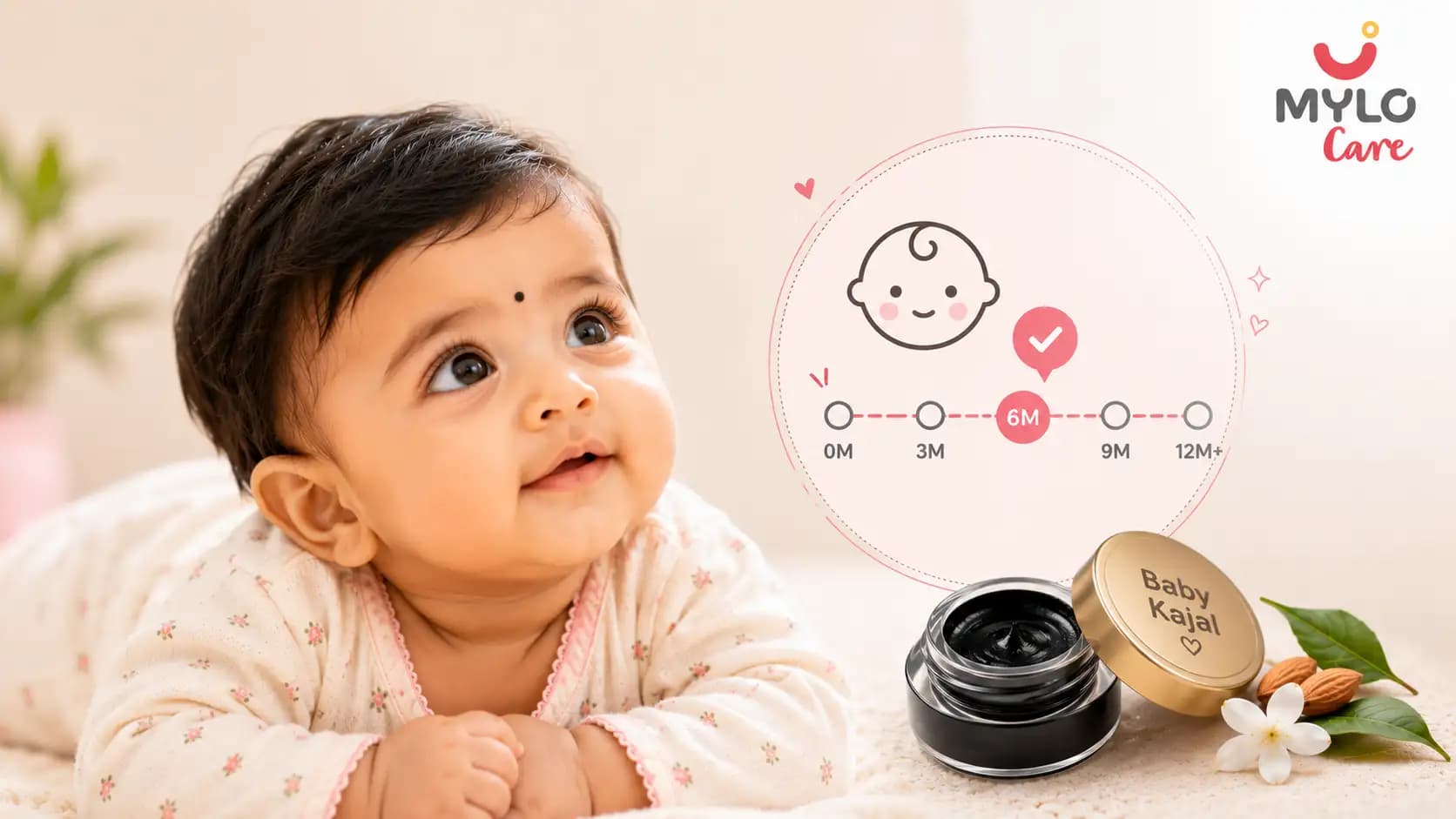
At What Age Can You Apply Kajal to a Baby?
 12 min
TL;DR
There is no medically recommended age to apply kajal (kohl, surma) inside or on the rim of a baby's eyes, health and paediatric authorities advise against it at every age because of the risk of lead exposure, irritation and infection (AAP) (WHO). The younger the child, the higher the risk, as babies absorb lead more easily and their eyes are more delicate (CDC). Traditional and homemade kajal is especially unsafe because it can contain lead (US FDA). If you wish to follow tradition, wait until the newborn stage has passed, keep any application well away from the eyes (a tiny dot behind the ear or on the foot), use a tested, transparent product like Mylo Baby Kajal rather than loose surma, and check with your paediatrician first.
Quick Answer
There is no safe age to put kajal in a baby's eyes; doctors advise against it at every stage. Newborns are the most vulnerable, and the risk of lead exposure and infection continues through infancy and toddlerhood. If you follow custom, avoid the newborn period, keep kajal away from the eyes, choose a tested branded product over loose surma, and ask your doctor first. The safest choice is to skip eye application altogether.
Author: Mylo Editorial Team, Mylo Parenting Desk
Medically reviewed by: Mylo Editorial Board, aligned with AAP, WHO and IAP guidance
Last updated: 9 July 2026
Medical Disclaimer: This article is for informational purposes only and is not a substitute for professional medical advice. If your baby has had kajal applied and shows symptoms like poor feeding, constipation, irritability, pale skin or persistent eye redness, contact your paediatrician promptly.
Key Takeaways
- There is no medically recommended age to apply kajal in a baby's eyes (AAP)
- Health authorities advise against eye application at every age (WHO)
- Newborns and young infants are the most vulnerable to lead (CDC)
- Traditional and homemade kajal can contain lead and is especially risky (US FDA)
- Kajal in the eyes can cause irritation, blocked tear ducts and infection at any age (AAO)
- If following tradition, wait past the newborn stage and keep it away from the eyes
- Prefer a tested, transparent product like Mylo Baby Kajal over loose surma
- Always check with your paediatrician before applying anything near a baby's eyes
Is There a "Right Age" to Start Applying Kajal?
Many families ask whether kajal is fine "after 40 days," "after the naming ceremony," or "after one year." From a medical standpoint, the honest answer is that there is no age at which putting kajal inside a baby's eyes becomes safe (AAP):
- The concern is not the baby's age but the ingredients (possible lead) and the location (the eye)
- Waiting a few weeks or months does not make lead safe; there is no safe level for children (WHO)
- Any substance placed in the eye can irritate it or cause infection, regardless of age (AAO)
So the useful question is not "at what age is it safe?" but "how can I honour tradition with the least possible risk?"
How Does the Risk Change with a Baby's Age?
Younger babies face the highest risk, but the concern does not disappear as they grow (CDC):
| Age Stage | Why the Risk Is High | Recommendation |
|---|---|---|
| Newborn (0 to 28 days) | Most delicate eyes; highest lead vulnerability; immature tear system | Avoid kajal entirely |
| Young infant (1 to 6 months) | Rapid brain development; high lead absorption; rubs eyes | Avoid in the eyes; keep away from eye area |
| Older infant (6 to 12 months) | Puts hands in mouth; can transfer kajal from face to mouth | Avoid in the eyes; if used, keep away and use tested product |
| Toddler (1 year and above) | Still absorbs lead more than adults; active and rubs eyes | Still not for the eyes; minimise and supervise |
Even for a toddler, kajal is not recommended in the eyes; the risk simply lessens compared with a newborn, it does not become zero.
Why Are Newborns and Young Babies Especially Vulnerable?
The newborn and early-infant period is when caution matters most (CDC):
- Higher lead absorption: A baby's body takes in lead far more readily than an adult's
- Developing brain: Early months are critical for brain and nervous-system development, which lead can disrupt
- Delicate eyes: A newborn's cornea and tear ducts are especially easy to irritate or block (AAO)
- Immature clearance: Their bodies are less able to remove toxins
- Hand-to-mouth behaviour: As they grow, they transfer substances from face to mouth, increasing ingestion
Possible signs of lead exposure, poor appetite, constipation, irritability, pale skin and developmental delays, are vague and easy to miss, which is why prevention is safer than waiting to react (CDC).
If You Choose to Follow Tradition, What Is the Safest Approach?
Many families want to keep the custom while protecting the baby. Reasonable, lower-risk steps include (IAP):
- Wait past the newborn stage: Avoid the first few weeks entirely, when the baby is most vulnerable
- Keep it away from the eyes: Apply a tiny dot behind the ear, on the cheek or on the sole of the foot, never on the lids or waterline
- Use it symbolically, not daily: A one-time ceremonial dot is far lower risk than daily eye application
- Choose a tested, transparent product: Avoid loose or imported surma and homemade lamp-soot kajal; prefer a labelled, lead-free-tested product such as Mylo Baby Kajal
- For the "evil eye": A cloth kala teeka or black thread serves the cultural purpose with no chemical risk
- Ask your paediatrician first: They can help you set safe boundaries and explain the risk to family elders
Does Kajal Help a Baby's Eyes at Any Age?
No. The common beliefs behind applying kajal early are not supported by evidence (AAP):
- It does not make the eyes bigger; eye size is genetic
- It does not improve or sharpen eyesight at any age
- It does not clean or protect the eyes; a baby's tears do that naturally
- The "bigger eyes" look is only a temporary optical effect of dark outlining
So there is no developmental "window" in which starting kajal benefits the baby; there is only added risk.
When Should You See a Doctor?
Contact your paediatrician promptly if your baby, at any age, has had kajal applied and shows (CDC) (AAO):
- Persistent eye redness, swelling, watering or discharge
- A white or cloudy spot on the eye surface
- Poor feeding, vomiting or constipation
- Unusual irritability, drowsiness or developmental concerns
- Pale skin or low energy (possible anaemia)
- Any suspicion of lead exposure, ask about a blood lead test
Myths vs Facts: Age and Baby Kajal
| Myth | Fact | Source |
|---|---|---|
| "Kajal is safe once the baby is 40 days old" | False. There is no safe age for kajal in the eyes | AAP |
| "Waiting until 1 year makes kajal safe" | False. Lead has no safe level for children | WHO |
| "Newborns need kajal to protect their eyes" | False. A newborn's eyes self-clean with tears | AAO |
| "Applying kajal early makes eyes bigger" | False. Eye size is genetic, not affected by kajal | AAP |
| "A little kajal at any age is harmless" | False. Even small lead doses can harm babies | CDC |
| "Homemade kajal is fine for newborns" | False. It can contain lead and is non-sterile | WHO |
| "Kajal improves eyesight if started young" | False. No cosmetic affects vision development | AAO |
Indian Context: What Indian Parents Should Know
- The "40-day" custom: Many families apply kajal after the newborn period as part of tradition; there is no medical basis for this being a "safe start," so keep it away from the eyes (IAP)
- Loose surma is highest risk: Traditional loose surma is among the most likely to contain lead and is untested (US FDA)
- Regulation and choice: Cosmetics in India are regulated by the CDSCO; prefer sealed, tested products like Mylo Baby Kajal over unbranded ones (CDSCO)
- Anaemia overlap: Indian infants often have anaemia; lead exposure worsens it, so avoid any added source (CDC)
- Talk to elders with support: Grandparents often insist based on love and custom; involve your paediatrician to explain the risk
- When worried: If kajal has been used from an early age, ask your doctor about a blood lead test
- Emergency number: For any serious symptom, dial 108 for ambulance services in most states
FAQs: Age and Baby Kajal
At what age is it safe to apply kajal to a baby's eyes?
There is no age at which kajal is considered safe inside a baby's eyes; health authorities advise against it at every stage because of lead, irritation and infection risks (AAP) (AAO). Newborns are the most vulnerable, and the risk continues through infancy.
Bacche ko kis umar mein kajal laga sakte hain? (Hinglish)
Aankh mein kajal lagane ki koi safe umar nahi hai, doctors har stage par isse mana karte hain kyunki isme lead, irritation aur infection ka risk hota hai. Newborn baby sabse zyada vulnerable hoti hai. Agar parampara nibhani hai to newborn stage ke baad, aankh se door (kaan ke peeche ya pair ke tale) chhota sa dot lagayein, loose surma ki jagah Mylo Baby Kajal jaisa tested product chunein, aur pehle doctor se poochein.
Can I apply kajal to a newborn?
It is best not to. Newborns have the most delicate eyes and the highest vulnerability to lead, so this is the stage where kajal should be avoided entirely (CDC). A newborn's eyes are naturally kept clean by tears and need nothing added.
Kya 40 din ke baad kajal lagana safe ho jata hai? (Hinglish)
Nahi. 40 din ya kisi bhi ceremony ke baad kajal aankh mein lagana medically safe nahi hota, kyunki lead ka koi safe level nahi hai aur aankh mein koi bhi cheez irritation ya infection kar sakti hai. Agar lagana hi hai to aankh se door lagayein aur doctor se salah lein.
Does waiting until my baby is older make kajal safe?
No. Toddlers still absorb lead more than adults and still rub their eyes, so kajal is not recommended in the eyes even at that age (CDC). The risk lessens compared with a newborn but does not disappear.
Is it okay to apply kajal on the cheek or forehead instead of the eyes?
Yes, this is a much lower-risk way to follow tradition. A small dot away from the eyes, such as behind the ear, on the cheek or on the sole of the foot, avoids the eye-specific risks, especially if you use a tested product (IAP). A cloth teeka is an even safer option for the "evil eye."
What kind of kajal is least risky if my family insists?
Avoid loose surma, imported kohl and homemade lamp-soot kajal, and choose a sealed, transparent, lead-free-tested product such as Mylo Baby Kajal (US FDA). Even then, keep it away from the eyes and check with your paediatrician.
My baby has been wearing kajal since birth. Should I worry?
Stop eye application and speak to your paediatrician, especially if it was loose or homemade kajal (CDC). Watch for signs like poor feeding, constipation, irritability or pale skin, and ask whether a blood lead test is advisable.
References
- American Academy of Pediatrics (AAP) / HealthyChildren.org. https://www.healthychildren.org/
- World Health Organization (WHO). "Lead Poisoning and Health." https://www.who.int/news-room/fact-sheets/detail/lead-poisoning-and-health
- Centers for Disease Control and Prevention (CDC). "Childhood Lead Poisoning Prevention." https://www.cdc.gov/lead-prevention/
- US Food and Drug Administration (FDA). "Kohl, Kajal, Al-Kahal, Surma, Tiro, Tozali, or Kwalli: Dangers of Lead Poisoning." https://www.fda.gov/cosmetics/cosmetic-products/kohl-kajal-al-kahal-surma-tiro-tozali-or-kwalli-dangers-lead-poisoning
- American Academy of Ophthalmology (AAO). https://www.aao.org/
- Central Drugs Standard Control Organisation (CDSCO), India. https://cdsco.gov.in/
- Indian Academy of Pediatrics (IAP). https://iapindia.org/
- Mylo. "Mylo Baby Kajal (5g)." https://mylofamily.com/product/mylo-baby-kajal-5g-3498
Article Posted Under
Related Articles


Medical Disclaimer
This content is for informational purposes only and should not replace professional medical advice. Consult with a physician or other health care professional if you have any concerns or questions about your health. If you rely on the information provided here, you do so solely at your own risk.


AWARDS AND RECOGNITION

Mylo wins Forbes D2C Disruptor award

Mylo wins The Economic Times Promising Brands 2022
AS SEEN IN












- Mylo Care: Effective and science-backed personal care and wellness solutions for a joyful you.
- Mylo Baby: Science-backed, gentle and effective personal care & hygiene range for your little one.
- Mylo Community: Trusted and empathetic community of 10mn+ parents and experts.


Product Categories
Baby Carrier | Baby Soap | Baby Wipes | Stretch Marks Cream | Baby Cream | Baby Shampoo | Baby Massage Oil | Baby Hair Oil | Stretch Marks Oil | Baby Body Wash | Baby Powder | Baby Lotion | Diaper Rash Cream | Newborn Diapers | Teether | Baby Kajal | Baby Diapers Pants | Cloth Diapers | Laundry Detergent | Lactation Granules |