


Orders
.png&w=48&q=75 "login")
Profile


Wallet

Exercises to Induce Labour: What the Evidence Actually Says
 743 Likes|
 15 min
AI-Generated Summary
Quick overview in 30 seconds.webp&w=32&q=75)
- As your due date approaches, gentle exercises like pelvic tilts, squatting, and birthing ball bounces can help prepare your body for labor and encourage a safe, natural delivery.
- Kegels strengthen pelvic floor muscles for the pushing stage, while butterfly pose, lunges, and hip circles open up the pelvis to help your baby descend.
- Low-impact activities like walking, stair climbing, and the cat-cow yoga stretch can naturally induce labor between 39-41 weeks while keeping you active and comfortable.
- What essentials can support your labor preparation? Explore our Baby Wellness Kit | Skincare Gift Set for Newborns.

 4.1
4.1 4.7
4.7Quick answer
No exercise has been shown to reliably start labour. What staying active in late pregnancy does do is keep you comfortable, maintain strength and stamina for birth, and in some studies is associated with shorter labour and fewer interventions. Movement is worth doing for those reasons. It is not a way to bring your baby out on a schedule, and some exercises are unsafe in specific pregnancies.
Key takeaways
Exercise does not induce labour. If your body and baby are not ready, nothing you do on a birthing ball will change that. Any article promising otherwise is overselling.
Staying active still helps. Better stamina, less back pain, easier positioning in labour and, in some research, shorter labour and lower intervention rates.
Contraindications matter more than technique. Placenta praevia, preterm labour, cervical stitch, high blood pressure, leaking fluid and several other conditions mean these exercises are not for you. Check the list before you start anything.
Deep squats are not for everyone. They are commonly recommended and are genuinely unsuitable if your baby is not head-down, if the head is still high, or if you have pelvic girdle pain.
If you have had a previous caesarean, do not try any self-induction method, including nipple stimulation or herbal remedies, without your doctor's explicit advice.
Can exercise actually bring on labour?
No, not reliably. Labour begins through a complex hormonal and physiological process that involves your baby as much as it involves you. Walking, squatting and bouncing on a ball do not switch it on.
The reason this belief is so persistent is that it feels mechanically plausible. Gravity, movement and an open pelvis sound like they should help the baby descend and start things off. And plenty of women do go into labour after a long walk, which is easy to read as cause and effect when it is usually coincidence at 39 or 40 weeks.
What research has looked at is different and more modest. Studies on physical activity in late pregnancy have examined whether active women have shorter labours, fewer caesareans or less need for augmentation, and some have found associations in that direction. That is a meaningfully different claim from "this exercise will induce labour today."
Why the honest version is more useful to you. If you believe an exercise should work, and it does not, the natural response is to do more of it, harder, at 40 weeks, when you are exhausted and your pelvis is already under strain. That leads to injury and disappointment rather than a baby. Knowing what these exercises are actually for lets you use them sensibly.
What does staying active in late pregnancy actually help with?
Benefit | How well supported | What it means for you |
|---|---|---|
Reduced back and pelvic pain | Good | The most immediate and reliable benefit |
Maintained stamina and strength for labour | Good | Labour is physically demanding. Conditioning helps |
Better sleep and mood | Good | Matters more in the final weeks than people expect |
Blood sugar control in gestational diabetes | Good | Often part of the management plan |
Familiarity with positions you will use in labour | Practical rather than research-based | Knowing how a ball or a supported squat feels beforehand genuinely helps on the day |
Shorter labour and fewer interventions | Mixed, some supportive studies | A reasonable possible benefit, not a promise |
Helping the baby get into a good position | Weak | Widely claimed, poorly evidenced. Do not rely on it |
Starting labour | Not supported | Do it for the reasons above instead |
Before you start: who should not do these exercises
This is the section the internet usually skips. Talk to your doctor before starting or continuing exercise in late pregnancy, and do not begin any of the exercises below if any of the following apply to you.
Do not exercise without specific medical clearance if you have:
Ruptured membranes, or any leaking of fluid
Preterm labour, or a history of preterm birth in this pregnancy
A cervical stitch (cerclage) or known cervical insufficiency
Placenta praevia after 26 weeks
Persistent bleeding in the second or third trimester
Pre-eclampsia or pregnancy-induced high blood pressure
Significant heart or lung disease
Severe anaemia
A baby with growth restriction
A multiple pregnancy with risk factors for preterm birth
Poorly controlled diabetes, thyroid disease or other significant medical conditions
Take specific advice before squatting, lunging or using a ball if:
Your baby is breech or transverse, or the head is still high and unengaged
You have pelvic girdle pain, symphysis pubis pain or pain over the pubic bone
You have had a previous caesarean
You have significant dizziness or low blood pressure
You have balance problems or have had a recent fall
Stop immediately and contact your doctor if you get
Vaginal bleeding
Leaking of fluid
Regular painful contractions
Dizziness, faintness or a headache that will not settle
Chest pain or breathlessness before you have exerted yourself
Pain, swelling, warmth or redness in one calf
Reduced baby movements
Severe pelvic or pubic pain
Ten exercises for late pregnancy, and what each is actually for
Exercise | What it genuinely helps with | Main caution |
|---|---|---|
Walking | Stamina, circulation, mood, back pain | Not risk-free. Avoid uneven ground, extreme heat and exhaustion |
Pelvic tilts | Lower back pain, core awareness | Generally very safe |
Cat-cow | Back mobility, comfort | Stop if it causes wrist or pelvic pain |
Birthing ball sitting and gentle rocking | Comfort, upright positioning, pelvic mobility | Correct ball size, feet flat, something to hold. Do not bounce vigorously |
Hip circles on a ball | Pelvic mobility, back comfort | Slow and controlled, not forceful |
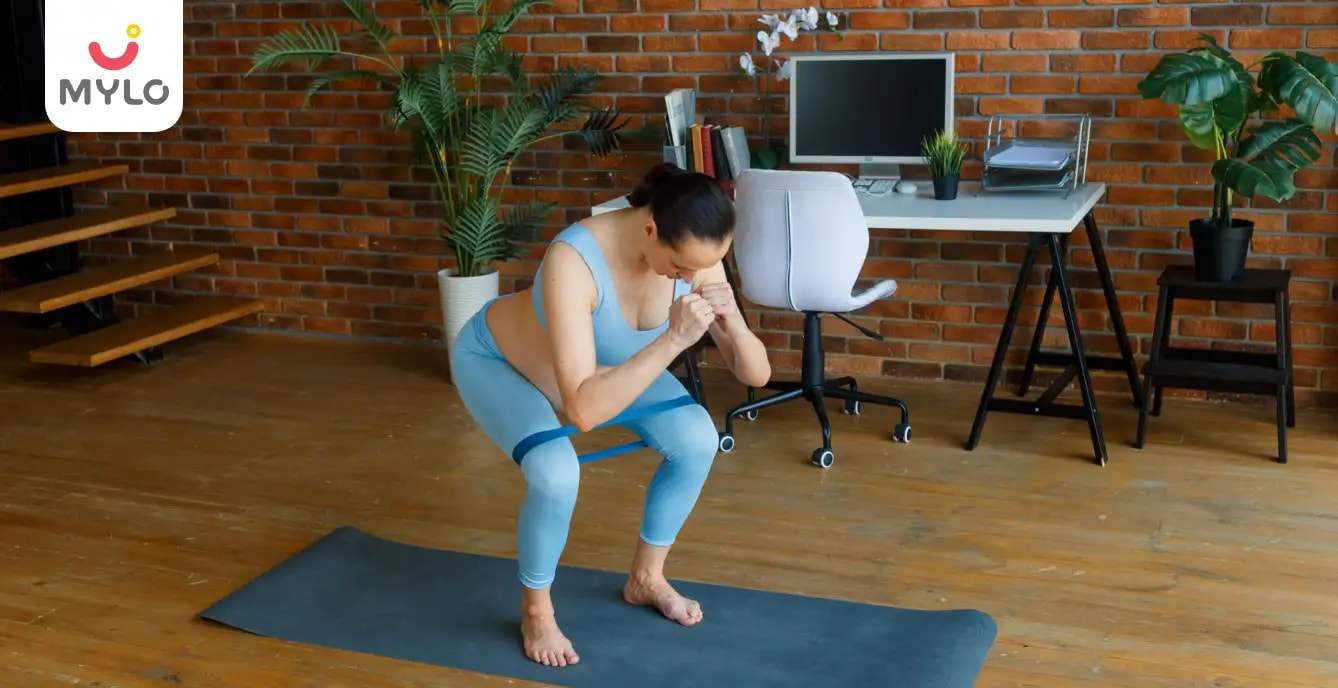
Supported squats | Leg strength, familiarity with a birth position | Not if baby is not head-down, head is high, or you have pelvic girdle pain |
Butterfly pose (baddha konasana) | Hip and inner thigh flexibility | Sit on a cushion, do not push knees down |
Pelvic floor exercises (Kegels) | Reduces urinary incontinence risk in pregnancy and after birth | Learning to relax the pelvic floor matters as much as strengthening it |
Lunges | Leg strength, hip mobility | High fall risk late in pregnancy. Hold a support. Skip if you have pelvic pain |
Stair climbing | Leg strength | Fall risk, and no good evidence it induces labour. Use the handrail, do not do it for hours |
How to do the four most useful ones
Pelvic tilts. On hands and knees or standing against a wall, gently tuck your tailbone under, flattening your lower back, then release. Ten slow repetitions, two or three times a day. Breathe throughout. This is the best single exercise for late-pregnancy back pain.
Sitting and rocking on a birthing ball. Choose a ball that lets your hips sit slightly higher than your knees with your feet flat on the floor. Sit tall, feet wide, and rock gently forward and back or in slow circles. Have a wall, sofa or another person nearby. This is useful as comfort and positioning practice rather than as an induction method, and it is one of the most genuinely transferable things to labour itself.
Supported squats. Stand with your back against a wall, feet shoulder-width or a little wider, and slide down only as far as is comfortable. Hold for a few breaths and come up. Depth is not the goal. If you feel sharp pain in the pubic area or groin, stop and switch to something else, because that suggests pelvic girdle pain rather than tight muscles.
Pelvic floor exercises. Squeeze the muscles you would use to stop passing urine, hold for a few seconds, then fully release. The release matters. A pelvic floor that cannot relax is not an advantage in labour. If you are unsure whether you are doing this correctly, a women's health physiotherapist can check in a single session, and many women are doing it wrong without knowing.
What to avoid, and what to be careful with
Method | Position |
|---|---|
Castor oil | Do not take it. It causes cramping, diarrhoea and dehydration, and is not a safe self-induction method |
Nipple stimulation | Can cause strong uterine contractions. Never attempt without your doctor's advice, and especially not after a previous caesarean |
Herbal preparations for induction, including cohosh and unspecified Ayurvedic or traditional mixtures | Avoid. Ingredients and strength are unregulated, and some have serious effects on the uterus and blood pressure |
Spicy food, pineapple, papaya, sesame and similar remedies | No evidence they induce labour. Mostly harmless in normal food amounts, but not a plan |
Ghee in the last month "for easy delivery" | A common belief in Indian households. No evidence it eases delivery, and it adds substantial calories at a stage when weight and blood sugar are being monitored |
Heavy housework, lifting or long stair climbing to "bring it on" | Raises the risk of falls and injury, and does not induce labour |
Hot tubs, saunas, very hot baths | Avoid. Raised core temperature is not advisable in pregnancy |
Deep or forceful abdominal massage | Avoid in late pregnancy |
Any self-induction method after a previous caesarean | Do not attempt. Uterine rupture is a real risk and this must be managed medically |
What if you are past your due date?
Only about one in twenty babies arrives on the estimated due date. Being at 40 or 41 weeks with nothing happening is normal and does not mean anything is wrong.
Your doctor will usually monitor you more closely after 40 weeks, with checks on your baby's growth, movements, heart rate and amniotic fluid. If labour has not started by around 41 to 42 weeks, medical induction is usually discussed, because the risks of continuing rise beyond that point.
This is the conversation worth having, rather than a stair-climbing routine. Ask your doctor:
How many weeks are you comfortable waiting, and why?
What monitoring will happen in the meantime?
What would induction involve here, and what are the options?
Is there anything about my pregnancy that changes this timeline?
A membrane sweep may be offered from around 40 weeks. It is a medical procedure done by a doctor or midwife, not something to attempt yourself.
When to call your doctor
Contact your doctor or go to hospital straight away if you have:
Reduced or changed baby movements. This is the single most important symptom in late pregnancy and should never be left until morning
Any bleeding
Leaking of fluid, whether a gush or a trickle
Regular painful contractions before 37 weeks
Severe headache, visual disturbance, upper abdominal pain or sudden swelling of the face and hands
Fever
Pain, swelling or redness in one calf
A fall or any injury to your abdomen
Do not try to work out at home whether the baby's movements are "enough." Counting apps and kick charts are no substitute for being assessed.
Frequently asked questions
Can exercise really induce labour?
No exercise has been shown to reliably start labour. Staying active is worth doing for comfort, stamina and possibly a smoother labour, but it will not bring your baby earlier.
Does walking help start labour?
There is no good evidence that it does. Walking is still one of the best things you can do in late pregnancy for back pain, mood and stamina. Walk because it helps you, not to trigger labour.
Is squatting safe in the ninth month?
Supported squats are fine for many women, but not if your baby is not head-down, if the head is still high, or if you have pelvic or pubic pain. Check with your doctor, and never force depth.
Can bouncing on a birthing ball bring on labour?
It has not been shown to start labour. Sitting and gently rocking on a ball is genuinely useful for comfort and for practising upright positions you may want in labour.
Is climbing stairs good for inducing labour?
There is no good evidence for it, and it carries a real fall risk late in pregnancy. If you use stairs, use the handrail and do not do it repeatedly to try to start labour.
Are Kegels useful before delivery?
Yes, mainly for reducing urinary incontinence during pregnancy and after birth. Learning to fully relax the pelvic floor is as important as strengthening it.
I am 41 weeks. Should I try natural induction methods at home?
Speak to your doctor instead. At this stage you need monitoring and a plan, and home methods such as castor oil, nipple stimulation and herbal remedies carry real risks.
I had a C-section last time. Can I do these exercises?
General movement such as walking and pelvic tilts is usually fine, but check with your doctor. Do not attempt any self-induction method, including nipple stimulation, after a previous caesarean.
How much exercise is appropriate in the third trimester?
For an uncomplicated pregnancy, the usual guidance is around 150 minutes of moderate activity across the week, adjusted to how you feel. You should be able to hold a conversation while exercising.
Does exercise reduce my chance of a caesarean?
Some studies suggest active women have fewer interventions, but this is an association rather than a guarantee. Many factors decide how a birth goes, and most are not within your control.
The bottom line
There is no exercise that will bring on labour, and being told otherwise sets you up for frustration in the hardest weeks of pregnancy. What movement genuinely offers is less back pain, better stamina, and familiarity with positions that will help you on the day. Check the contraindications before you start, be careful with squats and lunges if you have pelvic pain or your baby is not head-down, and if you are past 40 weeks, have the conversation with your doctor rather than working through a list of home methods.
Sources
American College of Obstetricians and Gynecologists, physical activity and exercise during pregnancy and the postpartum period
Royal College of Obstetricians and Gynaecologists, physical activity and pregnancy
National Institute for Health and Care Excellence, inducing labour
NHS, exercise in pregnancy and overdue pregnancy
Cochrane Database of Systematic Reviews, exercise in pregnancy, and interventions for induction of labour
World Health Organization, recommendations on induction of labour at or beyond term
Federation of Obstetric and Gynaecological Societies of India, good clinical practice recommendations
This article is for general information and is not a substitute for medical advice. Always check with your doctor before starting or continuing exercise in pregnancy, and contact them immediately if you notice reduced baby movements, bleeding or leaking fluid.

Trusted by Mamas Preparing for Their Big Day
Gentle support for your labor prep journey, helping you stay comfortable and confident as you welcome your little one.
Baby Wellness Kit | Skincare Gift Set for Newborns



Buddy Ultra-Light Baby Stroller - Blue
Baby Pram for Toddlers & Kids | 3 Point Safety Harness | 360° Front Wheel Swivel| Umbrella Fold



Article Posted Under
Related Articles


Related Topics
.webp&w=32&q=75)
Medical Disclaimer
This content is for informational purposes only and should not replace professional medical advice. Consult with a physician or other health care professional if you have any concerns or questions about your health. If you rely on the information provided here, you do so solely at your own risk.


AWARDS AND RECOGNITION

Mylo wins Forbes D2C Disruptor award

Mylo wins The Economic Times Promising Brands 2022
AS SEEN IN













- Mylo Care: Effective and science-backed personal care and wellness solutions for a joyful you.
- Mylo Baby: Science-backed, gentle and effective personal care & hygiene range for your little one.
- Mylo Community: Trusted and empathetic community of 10mn+ parents and experts.


Product Categories
Baby Carrier | Baby Soap | Baby Wipes | Stretch Marks Cream | Baby Cream | Baby Shampoo | Baby Massage Oil | Baby Hair Oil | Stretch Marks Oil | Baby Body Wash | Baby Powder | Baby Lotion | Diaper Rash Cream | Newborn Diapers | Teether | Baby Kajal | Baby Diapers Pants | Cloth Diapers | Laundry Detergent | Lactation Granules |